

I drifted into consciousness slowly the next morning, as if the previous day required a deeper sleep to account for its grandeur. However, it was not thoughts of Bryce Canyon which woke me.
Shouts emanating from the bathroom informed me that Heather couldn’t turn off the bathtub faucet and water was spraying onto every surface in the bathroom. I rolled out of bed, and for about twenty minutes, we jerked the handle back and forth to no avail while trying to avoid the erratic soaking streams emitting from the faucet. There was no choice but to call the front office for reinforcement. A knock on the door signaled the arrival of the motel’s handyman, and he cautiously entered the warzone; we left him to it and began putting clothes into our duffel bags, but within seconds, the squirting sound ceased. I looked at Heather, puzzled, and the man exited the bathroom with questioning eyes.
“That was fast! How did you fix it?” I asked.
“Oh, it wasn’t that hard. I just pulled the handle straight down, and the water stopped,” he said, the corners of his mouth quivering upward.
With that crisis behind us, the handyman’s wife stopped by to see how we were coming along. We caught her up to speed, and soon the four of us began chatting. The couple told us they were caretakers at the motel and had actually moved to Utah just a few months before from South Hill, Virginia.
“No kidding!” Heather said. “We are just north of Williamsburg, only a couple hours away from there.”
“Really?” the man responded. “Well, I’m related to about half the town so the next time you’re down there, tell everyone I said ‘Hi!’”
His wife talked about the different way of life they had discovered in the West: the greater presence of nature and smaller population, the annual hot air balloon festival held near town every summer, the isolation from cities, chain stores and restaurants.
“But Southern cooking,” the handyman closed his eyes and slowly shook his head. “Nothing beats that.” His mother had roots in Louisiana and the cuisine of the Deep South, he told us, “and she could cook a wicked gumbo!” He had carried on his mother’s culinary traditions and now cooked as much as he could; his wife wore a sly grin and said she was more than happy to let him take up residence in the kitchen.
By 10:30, we needed to get on the road, so we thanked the two for their hospitality (and plumbing skills) and loaded ourselves into the sedan.
“If you’re ever in Panguitch,” the woman smiled, and our fellow Virginians waved as we pulled out of the motel and onto the dusty two-laner that cut through town.
****
A little more than an hour’s drive from Bryce Canyon lies Zion National Park’s east entrance, making the two parks sisters for the great train of tourists moving north from the Grand Canyon or south from Wyoming and Salt Lake City. These visitors form a sort of community as they migrate from one park to the next and share experiences at each stop. That afternoon at Zion’s visitor’s center, I would spot a mother and her son who had been on the trail ride alongside us just the day before in Bryce. I couldn’t remember their names or where they were from, but we shared an unspoken camaraderie as we savored the pristine landscapes preserved by the National Park Service.
On our way south, we reasoned that we should try to find lunch outside Zion to avoid overpriced fast food, and as luck would have it, a German café named Forscher’s appeared on the side of our narrow road. We turned in, and I found myself walking into a modern log building with vaulted ceilings, exposed beams, and a corrugated metal roof. In front of us behind glass cases was arrayed a feast of European breads, cheeses, and pastries: gouda sandwiches with sour apple jelly, Mediterranean loaves, hard salami subs topped with arugula and spread with mustard, Wave of the Danube cake garnished with ganache. I had to remind myself that I did have a budget to adhere to as I chose from the smorgasbord. Then, we sat down to our meal in the heat of the bakery’s patio, the flavors that greeted my tongue making me shiver with pleasure.
After lunch and once we had finished checking email and Facebook at this rare cyber-oasis, we continued down Route 89 another five miles and made a right. Just past Zion’s welcome sign, I received my first taste of quite a different sort of terrain than what I had already encountered. Checkerboard Mesa, an imposing sandstone hill, sloped upward from the road and far into the sky. True to its name, an infinite grid reminiscent of an Agnes Martin painting was lashed onto its surface, partitioning the stone into imperfect rectangles. In Bryce l had spent most of my time looking down into the canyon, but here it seemed I would be looking up.

We continued on, snaking inwards, and after nearly half an hour swerving around outcroppings, Heather plunged the car into a mile-long tunnel which provided access to the main canyon. My eyes gradually adjusted to the inky blackness, but up ahead I could see a shaft of light illuminating the ground ahead. All of a sudden, we passed through the beams, and on my right a hole cut into the side of the chiseled tube flashed us a glimpse of what was outside. A towering stone face adorned with shrubs. A shoelace road swinging back and forth and down to the valley floor. We passed several more of these windows; then, after a few more seconds of darkness, the door into Zion swung open in front of us.
I had read that members of the Southern Paiute who originally lived in this area referred to it as Mukuntuweap, meaning ‘Straight Canyon,’ because of the dramatically steep angles at which the mountains rise. Later, Mormon pioneers arriving at the end of the nineteenth century connected the beauty they saw to what they read in the Bible, giving formations names such as the Great White Throne, the Court of the Patriarchs (for Abraham, Isaac, and Jacob of the Old Testament), and the Altar of Sacrifice. Even the name Zion references the holy city of Jerusalem in the Promised Land where God led Israel after their four-hundred-year exile in Egypt. Clearly, this land had been treasured for generations, and going farther into the park, I understood why.
Outside the tunnel, red rocks soared all around us, and a wide natural arch seemed to seal the valley from the eastern section of the park from which we had just come. I now felt like I was in the bottom of a cradle peering up at its unfathomably high walls. The floor of the canyon was narrow, so cars moved single-file through the landscape, but within a half-mile the valley widened as it connected with the main canyon. Virginia certainly does not do this, I thought.

Because travelers can only access the upper canyon by tram during the summer, we crossed the Virgin River and followed its flow downstream to the visitor’s center to park our car. There, the water seemed to be a jubilant and shallow stream, so Heather suggested we wade through on our way to the main building to cool off; in retrospect, it might have been a better idea to use the bridge, but at least Heather’s tablet wasn’t permanently damaged after submersion. Three steps across tottering stones and sand, Heather lost her footing, and she and the bag around her shoulder were dunked into the water. I heard her holler and started fording the current to give her a hand, but then I felt one of my sandals slip off and turned to watch it begin slaloming downstream toward minor rapids. Once I knew Heather was okay, off I went on another rescue mission. Despite all of this, Heather and I, already enchanted with this haven tucked into the Utah desert, christened Zion as our favorite park of the trip.
After drying off and filling our water bottles, we scurried to a tram which would take us to one of the park’s most popular and treacherous hikes: Angel’s Landing. I had initially learned of the two-and-a-half-mile hike in a guide book. Numerous switchbacks lead to the summit 1500-feet above the canyon floor echoed through my head. It sounded fairly straightforward except for one detail: Angel’s Landing is famed for its final quarter-mile rock scramble along a narrow ridge to the peak. The good news? Metal chains periodically drilled into the “path” were available for support in case one lost one’s balance at the edge of a precipice. What a relief, I thought.
The tram let us off just across the road from the trailhead, and while I gathered my fortitude, I read the hiker information posted nearby. “Your safety is your responsibility” was printed in bold letters along the bottom of the sign.
“I suppose this means there isn’t an elevator to the top?” I asked Heather.
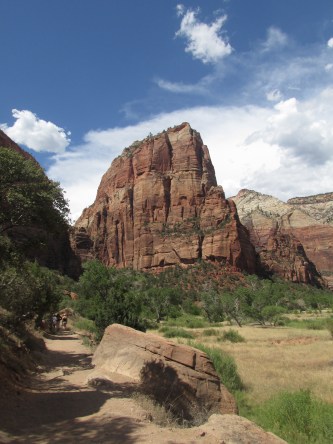
I have never been eager to work out; essaying or poring over novels has always felt more productive to me because these exercises challenge my mind and imagination. Yet here I was at the start of a strenuous-level hike which I had seen on a list entitled “Top Ten Hikes for Adventure Seekers.” When we planned our vacation, I knew visiting National Parks would require more exertion than a day at Disney World, but had I been crazy to think I could transition from a sedentary desk job to covering miles of trail every day and summiting mountains in the process? There was only one way to find out.
The path began as a gentle stroll along the Virgin with Fremont Cottonwoods providing grains of shade from the July sun. Unfortunately, it looked like this would be the easiest part of the next four hours since I knew a series of demanding switchbacks, inclines, and technical hiking would soon arrive to complicate the meandering trail. Nonetheless, to my surprise, I felt my breath already becoming shallow, so our progress came to a halt beside some shrubs to let our bodies rest. Over the first half mile, I lost count of the number of breaks we took just to let oxygen catch up to our lungs; now I was getting concerned about the parts of Angel’s Landing that weren’t exactly a riverside amble. We pushed forward, and our path turned into a climb that left the canyon floor and flicked back and forth on the side of a stone wall as it ascended. I was thankful and amazed to find my stamina increasing as we hiked, perhaps a result of my body realizing it would be ascending the mountain whether or not it wanted to, and miraculously, we were able to muscle up the thirty-five-degree inclines and into Refrigerator Canyon in the shadow of the peak. After time to recover in the coolness, we came upon Walter’s Wiggles, a set of twenty-one more steep switchbacks which, despite their brevity, required awesome amounts of leg strength. Fatigue was creeping back into both of us, so we agreed to take the switchbacks two at a time with a minute in between to breathe.
Finally, we arrived at Scout’s Lookout, the point in the trail where exhaustingly exerting evolved into terrifyingly technical. I could hardly believe how far we had come when I looked out over the edge of the cliff into the canyon below; minute hikers at the trailhead appeared to be shuffling along even more slowly than we had been an hour ago. Up ahead, I spotted another sign and walked over after having a deep drink of water from my Nalgene. A warning, it promised danger all the way to the top. The last bit, after all, was tricky, as I had known: Over the past decade, at least half a dozen hikers had fallen from the trail on the way up. I knew this caution was serious, but after pushing through the pain of the last two miles, I knew I wouldn’t be satisfied with turning around now, even if it meant relying on adrenaline to carry me the rest of the way.
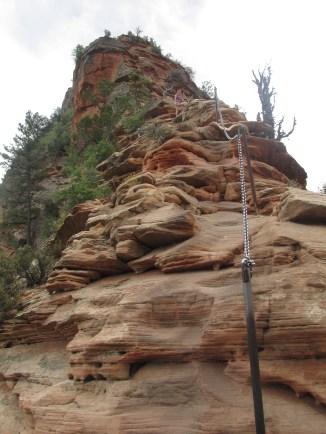
Up. Up and straight ahead we went, all the while becoming aware of a thunderstorm that had suddenly cropped up in the northwest and was blanketing the sky. Apparently, we were facing both a hazardous trail and exposure to severe weather. Rocks covered the ridge in front of us as if a rock slide had tumbled down the steep hill and had never been cleaned up. And yet, as I hoisted myself up each makeshift step with the faithful chain I had read about now at my side, I couldn’t truly grasp the danger close at hand. It was when I passed other hikers and we all had to locate a safe place to step to the side or an outcropping to lean against that I realized how perilous one misstep could be. After twenty to thirty minutes of navigating this ersatz staircase, the ascent leveled off so that the last few hundred feet felt like walking along the ridge of a roof which slanted downward on my right and left. I wondered how it must feel to lose one’s balance and begin tripping or tumbling toward the edge. What could you do to stop yourself from plummeting into the abyss? I hesitated to imagine.
Thankfully, the question remained unanswered for me, and I reached the apex of the mountain, the modest table where angels might land to worship God on the adjacent peak of the White Throne. The canyon stretched out before me, appearing like the bed of a deep river which had dried up and left its walls and floor verdant and full of vegetation. In fact, I was looking at the effects of steady erosion, but not caused by a mighty stream; instead, this was the work of the seemingly docile Virgin River, carving its way over time through hundreds of feet of solid stone. Every time a rock cleaves off her bank or a pebble dissolves into sand, Zion reveals her origins as well as her future.
Behind me I could spot the beginning of the trail like a length of fallen twine, the way we would have to return. But first, celebratory pictures were in order. Heather scooted down the polished slope so I could take her photo with the view in the background, and then she took my own. Four years later, I recognize the feelings prompting my smile: The incredulity that I could be two thousand miles from my home, standing atop a mountain that I had conquered, and able to experience a majestic portion of God’s creation tucked into a corner of Utah.
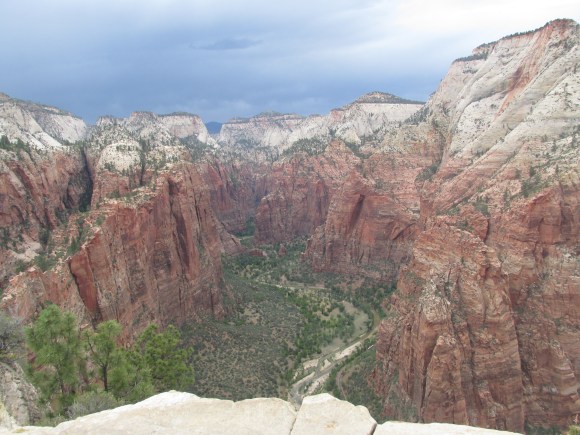
It was time to go. Lightning flashed nearby, and we were currently at one of the highest spots in the area. As nice as it would have been to have the pain in my legs eliminated by a jolt of electricity, I couldn’t bear the thought of missing out on the rest of our trip. We retraced our steps, rode the tram back to the visitor’s center, found our car and headed out through the tunnel and over to the town of Kanab on Utah’s southern border where we would be spending the night. Heather pulled into a McDonald’s, one of the few familiar restaurants we encountered on our trip, and we sat down to a meal of hamburgers and fries. Just by looking at us, a tad grimy and slumping in our seats, who would have guessed we had stood on our Mt. Olympus just that afternoon?
 The Barefooted Soul