

The second largest cliff dwelling in Mesa Verde National Park, Long House is also one of the most isolated: Reaching the complex requires a lengthy drive from the park’s visitor’s center, a tram ride, and, finally, a mile-long hike through the backcountry. So, when our tram puttered to a stop beside the trailhead, I hopped off with growing anticipation. Before we embarked on the last leg, a park guide motioned us forward to warn us of the fast-acting effects of heat exposure. “Just take it easy,” she said. “We’re not in any rush. And if you need to stop to catch your breath and have a drink of water, just let me know.” Despite her admonition, I didn’t feel too concerned. Clearly, I didn’t, or I wouldn’t have planned this nine-day gauntlet in the first place.
Once I had finished mapping out our trip months before, I realized that I had crafted an itinerary rife with strenuous trails which threaded through rivers, plunged into canyons, and summited mountains. Of course, this would be ideal for a physically-fit thrill-seeker, but perhaps not for someone whose daily workout consists of traversing the parking lot outside his office. Nonetheless, I refused to strike any of these sublime hikes from our route simply because I didn’t walk on a regular basis. I promised myself that I would soak in as much of the West as I could, even if there was a slight chance my body might collapse into a heap of abused muscle and bone in the process.
This cavalier attitude came back to haunt me when I came face to face with the colossal Angel’s Landing and was nearly reduced to crawling up her innumerable steep switchbacks. I had hoped that jogging a couple nights on the treadmill in my basement would be adequate preparation for the trip, but once I left Tidewater Virginia and arrived in Utah, where the average elevation hovers around six thousand feet above sea level, I was forced to concede that neither my leg muscles nor my lung capacity was up to par. The lower oxygen levels and relentless heat frequently prevented me from focusing on more fundamental matters, such as hiking out of canyons before twilight, dodging rattlesnakes I could hear but not see, and skirting the edges of death-drop overlooks the park service so often considers beauty spots. With the end of our vacation in sight, I felt like I had subjected myself to a week-long Tough Mudder without training beforehand. But, how could I pass up the scenes of unparalleled splendor that always seemed to be waiting just a few miles downcanyon or upstream.
This afternoon in Mesa Verde was no different: The impressive cliff dwellings of Long House were only a mile away, and I had made up my mind to go. As our trail guide led us down the side of the plateau into full view of the sun, however, I realized this would be yet another challenge I had not anticipated. Short trees and shrubs lined the trail, none offering much shade, and as we approached a series of switchbacks teeming with rocks of all sizes, I was beginning to wonder if long in Long House referred to the sweltering, ankle-spraining path in front of me.
Just minutes into the hike, I was already struggling to catch my breath. I knew the ranger’s announcement had been serious, so I paused for a moment to gulp down as much oxygen as I could. Hoping I would not incur any irreversible damage to my body over the course of the next hour or two, I also took a generous swig of water and prepared to fend off the impacts of heat and high elevation on my body. I would take it easy, but I planned to make it.
Sand-colored façades fronted by a wide terrace appeared at the end of the valley, and before long, the park ranger was beckoning us onto this ancient patio where we could rest and take in the site as a whole. Long House appeared to be recessed farther into the rock than Cliff Palace, meaning the complex was already mostly shaded by the time we arrived in mid-afternoon. Looking more closely, I noticed the massive stone archway  overhead held secrets of its own: Fissures along its side were sealed with clay bricks, hiding unreachable slender rooms.
The broad grassy terrace made Long House a roomier alternative to the crowded array of homes at Cliff Palace, but the site seemed to have suffered more with the passage of time. Rooms with knee-high walls looked as though the brick mason had left halfway through construction; others had little more than foundations left, as if grenades had been thrown inside. In the late 1800s, early explorers in what would become Mesa Verde National Park had plundered cliff dwellings for artifacts, causing considerable damage to the structures in the process. Looking at the ruins around me, I wondered if Long House had been one of the victims of this anthropological looting.

I passed by now-familiar kivas and followed the tour group up a pair of ladders which led into a recess behind the dwellings. To my surprise, I emerged into a shaded alcove 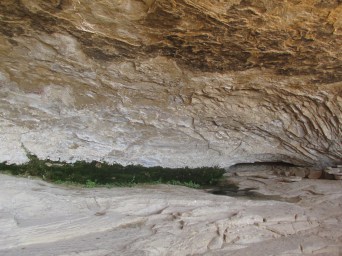 carpeted with moss and lush plants. “Whenever it rains up on the surface,” the ranger explained, “water seeps into the porous sandstone and journeys downward until it reaches a layer of shale, a rock which is much less absorbent. When it does, the rainwater is forced out of the rock, forming a seep spring as it does here.” The moist environment created by this adventurous rainwater never fails to attract hydrophilic moss, a process which reminded me of Mossy Cave in Bryce Canyon and the tiny bubbling pools along the walls of the Narrows in Zion National Park.
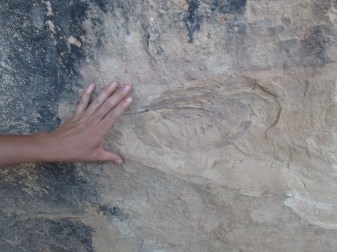 From this higher vantage point, I could look out over the shrubbed valley we had just hiked through, and I realized again how remote Long House is. No sound of traffic pierced the air, and no trace of humanity could be seen other than the earthen trail that wound its way into the distance. As we moved among the dwellings, peering into windows and doorways, Heather pointed out a faded fossil embedded in the stone wall behind us. As I studied its elliptical form, however, something else caught my eye. On the same wall just a few feet away, the faint outline of a handprint in ochre materialized. Without thinking, I placed my hand onto the cool stone, covering the slightly smaller handprint with my own. Centuries earlier, someone had stood in this very spot and pressed their pigment-stained palm against the stone as I did now. Who are you? I thought.
  Maybe a mischievous child, wondering if anyone would discover her secret. Or a teenager wanting to leave his mark on the world in some small way. Or perhaps an artist who beautified the spaces the cliff dwellers inhabited, adding color and a human touch onto otherwise barren, dusty surfaces. I stood silently for a moment, feeling the heavy weight of the years in the dark alcove behind the clay homes. Then, I stepped away, my hand revealing once more the unmistakable mark of humanity upon the wall.
During the tram ride back to the outpost and our final drive across the verdant ridges and valleys of Mesa Verde, I marveled at the ingenuity of the cliff dwellers. They had built their lives in the unlikeliest of places, and they had done so with a grandeur that could still be witnessed hundreds of years later. Then, just as unexpectedly as they had arrived, the cliff dwellers vanished, leaving behind only “shadows of the past,” in the words of our ranger at Cliff Palace. We could only guess at the contents of their lives by exploring the homes that still stood and searching for clues which lay beneath the sand and earth. But having witnessed these architectural wonders in such an intimate way, I felt that the cliff dwellers must not have been so different from us but filled with the same needs for survival, beauty, and significance at the core of every human life.
Our rental car turned out of Mesa Verde a second time, and a few minutes later, Heather pulled into Wendy’s for Frosties, a taste of the modern age to energize us for the road to Moab, Utah. As chocolate crystals dissolved around my tongue, I turned in my seat for one last look at the ripple of mountains guarding secrets deep within its labyrinth.
 The Barefooted Soul