

Ancient Native American etchings intermixed with names of travelers who had stopped by this rock in the 1800s. I recognized some of the drawings: a man on horseback, bow and arrow in hand; a cluster of animal tracks; a peace sign. Others were more abstract, such as swirls and tight ripples which curled around the carvings and gave the composition a sense of movement. A row of figures even resembled Saint Nicholas and three of his reindeer, but I’m not convinced that Santa, coming from such a cold climate, could have endured the Utahn summer long enough to have his portrait made.
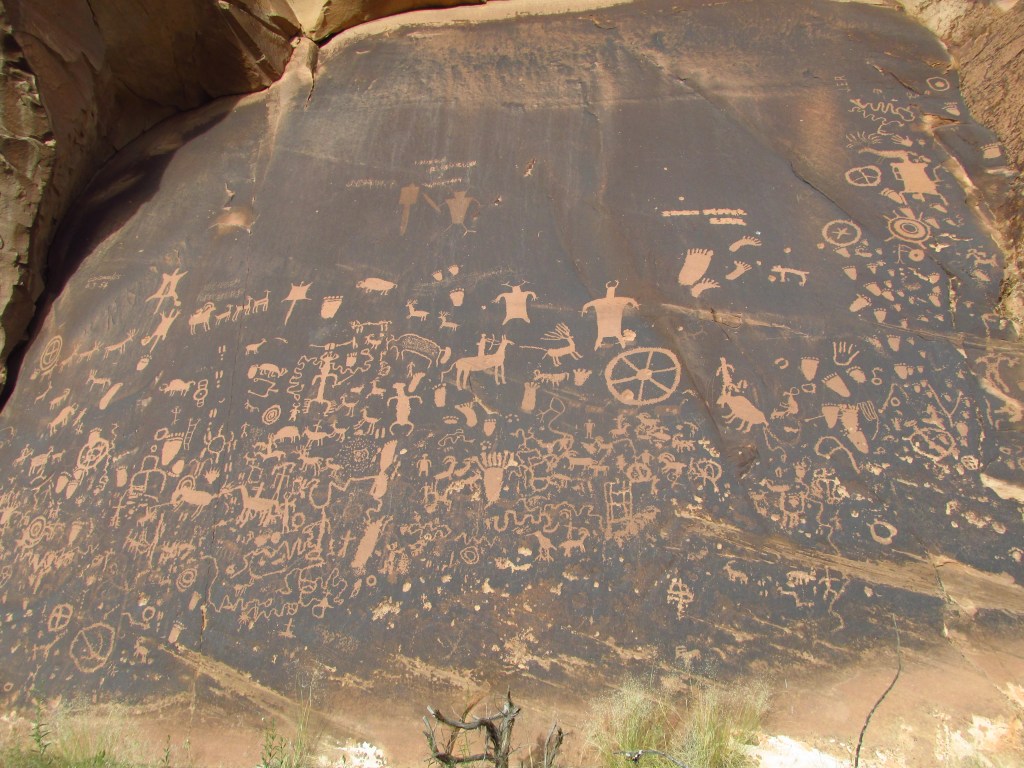
My sister and I were mesmerized by the coffee-colored Newspaper Rock State Historical Monument in eastern Utah, a chance detour as grand as its lengthy moniker. An informational plaque stated that the earliest carvings had been made two thousand years ago, and I wondered why artists had been drawn to this portion of stone again and again over the years and what their intentions might have been. The crowded surface could have been retelling the story of a great hunt, describing local wildlife, or pulling back the veil on a greater mystery I couldn’t fathom. Some had tried to join the narrative centuries later with a signature and a date, much to my chagrin, but I just stood back and allowed my eyes to roam over the two-dimensional herds and the curving lines weaving around them. My greatest contribution to Newspaper Rock was to be present among the invisible hands which had worked the stone, preserving fragments of their histories and cultures in the process.
Returning to our rental, we retraced the meandering, two-lane road we had taken a gamble on to find Newspaper Rock and turned back onto Route 191 toward Moab. We had spent the morning and afternoon among the cliff dwellings of Mesa Verde in Colorado, and in a couple hours, our grand tour of the West would culminate in the high desert of Arches National Park. This arid, high-elevation park already felt familiar to me since so many of the cars we had passed in the last week bore the image of Arches’ most famous feature on their license plates. It seemed appropriate that our introduction to the park would be a sunset hike to that very spot: Delicate Arch.

Along the road, fragile rock spires pierced the air, and massive boulders littered otherwise flat ground. One such rock flaunted its girth like a gigantic wedding cake, or perhaps a snowman with an unusually large belly. Our GPS labelled it Church Rock, but I couldn’t see the resemblance. As our road circled around it, the structure revealed a long sloping tail, and I couldn’t help thinking of the slug-like creature, Roz, from Pixar’s Monsters, Inc.
Rows of houses began to encroach upon the wilderness, signaling that we were fast approaching one of the Southwest’s rare cities. Once in Moab, sporting goods stores and fast-food restaurants that reminded me of my life back East tantalized me, but with the sun favoring the western sky, we kept our pace. Just north of the city, a bridge spanned a healthy-sized river, and I was shocked to see a sign saying that a juvenile Colorado River was passing underneath us. The serenely-flowing current seemed to be oblivious to its grand undertaking miles to the south. I suppose we never know what adventures lie just downstream.
A couple miles on, we arrived at the entrance to Arches, and Heather pulled over just inside the gates to rifle through her wallet for our national park pass; meanwhile, I gazed out my window, wondering where Arches National Park actually was. We were idling on a narrow strip of land fenced in by the main road on one side and rocky hills on another, and there seemed to be room only for a visitor’s center, a few attendant booths, and a fair bit of traffic between the two. My unspoken question was answered by the sight of a posse of cars slowly threading up the side of a rock face which bolstered the Arches plateau, much like a highway version of the Angel’s Landing ascent. A few minutes later, we were climbing the same road toward the sky, but the main park grounds remained elusive, even as the environs of Moab fell farther and farther out of reach to our right. It was only when our car could ascend no further and we crested the ridge overlooking eastern Utah that Arches truly opened up before us.

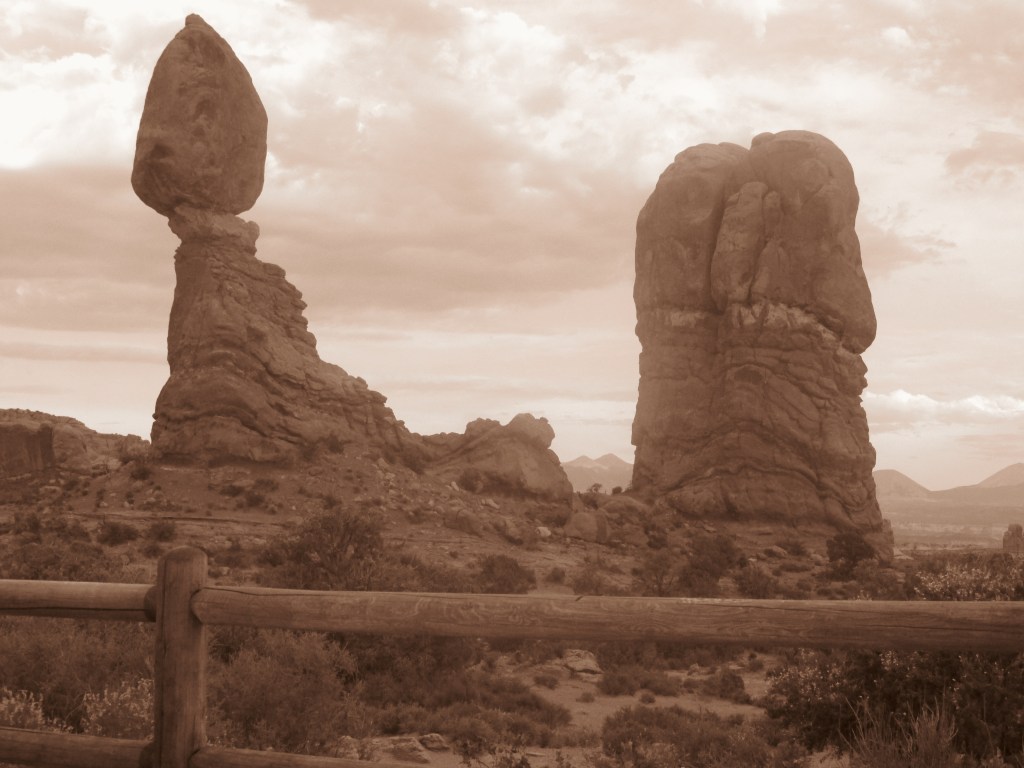
Despite our proximity to the city, I felt lightyears away from any civilization in this Martian terrain. Crumbling terra cotta towers and giant amorphous rock structures which sagged like old sofas vied for our attention as we entered the fairyland. A single turret known as Balanced Rock appeared to totter right beside the main road like a broken egg cup threatening to send its occupant plummeting into the middle of our path. Its impossible poise illustrated one the overarching themes of the park: we were in a precarious land, one which boasted eternal structures which nonetheless contained a dynamic potential ready to make itself known at any moment.
 The Barefooted Soul