
“Excuse me,” a guy said as he leaned across my chest with a camera. In the already confining cabin, the sleeve of his floral button-up was a bit too close to my nose for my liking.
Fifteen minutes earlier, the captain had let us know our plane would be crossing over the eastern end of the Grand Canyon, and those of us sitting near windows had positioned ourselves to peer out the hazy, scratched glass to catch a glance of the marvel.

Sure enough, the earth below had begun to crack as we moved northward, tantalizing me and making me wonder what I couldn’t see beneath me and to the west. Within a week, I would be looking out over the canyon from its edge, but for now I would have to satisfy myself with glimpses from above. Our view of the canyon gradually receded, and to my relief the window beside me was no longer crowded with cameras and craning necks. Mountains became visible to the northeast, high golden domes of stone floating above the endless orange rock of southern Utah; a half hour after that, even higher crests frosted with snow replaced these.
****
I make my home on the other side of the continent in Tidewater Virginia, a flat part of the country ruled by rivers and creeks which demarcate our counties and separate the land into peninsulas jutting into the Chesapeake Bay. So, on my first flight, from Norfolk, Virginia to Washington, D.C., I paid less attention to the scenery as I did to the roads and buildings as rural transitioned to urban; during my flight to Phoenix, however, the landscape itself gradually became unrecognizable to me. The verdant coast of my childhood lifted into the undulating Appalachians before flattening out again; then, the ground became denuded as trees disappeared in the Great Plains. Interstates that were usually forced into meandering curves by the land straightened out into well-organized grids uninhibited by nature. But an hour later, a rapid growth spurt shoved the plains up into the dizzying Rockies, and I lost sense of our direction as I peered down into the nests of humanity among the peaks. Then, the range deflated into the deserts of Arizona, and we touched down in Phoenix where I would meet my connection to Salt Lake City. How could five hours in the air bring about such dramatic change? I thought to myself. In a half-day’s travel, the photographs of the West that I had carried around in my mind for years were already being discarded and replaced with what I could now see around me.
Three months before, I had been a senior at Houghton College in upstate New York. One afternoon, just before a class on Intercultural Studies, my phone lit up with the name of my sister, Heather. I answered, and she cut straight to the chase: “Would you like to know what your graduation gift is?” In an instant, my thoughts flitted from the newest generation iPod and an expensive pair of red Air Jordans I had been pining for to a trip to Disney World. But when I finally told her to spill the beans, I hadn’t expected her to say, “Well, I’m going to be attending a math conference in Utah this June, and I thought you could join me out there after I’m finished, and we could drive around for a week and see the National Parks. Mom and Dad have agreed to help pay for your flight, and I can cover the rental car. So, what do you think? Do you want to go?” I had not anticipated that idea.
In my surprise, I started Googling pictures of the Southwest and the public lands there. Glossy renderings of stone arches and rugged mountains piercing cloudless skies caught my attention; within minutes I was sold on the proposal, and our hallowed itinerary became my primary focus once I graduated a month later.
Questions abounded: How many hours (or days) should we allot for Bryce Canyon? How much do motels cost near the Grand Canyon? Where in Arizona did John Wayne film The Searchers? Timetables and maps filled a spare green notebook leftover from college, and I even spent an entire afternoon sitting in a Barnes & Noble café, flipping through a myriad of National Parks guides to get my bearing on the land. Pretty soon, excitement over our destinations turned into stress over the places we didn’t have time to visit. I tried to work out a plan where we could go to both the Grand Canyon and Yellowstone, but a fourteen-hour drive separated the two parks. I would be kidding myself if I thought it would be a good idea to spend an entire day on the road just to have the afternoon in Wyoming. Before I was aware of it, the meticulous planning was over, and I could feel my plane touching down beside the salt flats of Utah’s capitol city. This was it. I had arrived at the beginning of my itinerary whether or not I was ready. But regardless of what happened over the next nine days, I was convinced I would be seeing and doing things I never had before or could even imagine.
****
My duffel bag wasn’t difficult to heft down from the overhead compartment since it contained only five sets of clothing. Laundry was yet an unanswered question, so I hoped I wouldn’t sweat too much in case I had to rewear. I turned on my phone as I walked into the terminal, and a call immediately came through from Heather: “You’re here! We’re just outside baggage.” And with that, I navigated the airport, spotted the silver Nissan which would be our mobile home for the next two thousand miles, and reunited with my sister six states west of where I had last seen her.
“And this is Beate, a friend I met at the math conference up in Snowbird,” Heather said as she introduced me to a woman with hazelnut hair. Originally from Germany, Beate was a student in England, but since this was her first time in the United States, she had decided to hang around Salt Lake City for a few days to get a taste of American life. None of us had been in the city before, so for the first day we would be exploring it together.
Heather hopped back into the driver’s seat, and we headed into traffic for lunch. The first place I remember seeing was Carl’s Jr., a fast-food chain advertising Thickburgers; however, I was puzzled because the logo and building design looked identical to that of another restaurant I knew in the East: Hardee’s. I later learned that these two establishments are basically identical twins but with different names. At the moment though, I was even more baffled by something else: Why was the ‘s on Carl instead of Jr.? Perhaps Carl had a son? The unresolved question still nagging at me, we whizzed past and pulled into a Taco Bell instead.
In college, I had trained as both a writer and a linguist with a particular interest in regional dialects. Naturally, I decided to investigate the Utahn pronunciation of Nevada. I had never been sure which a was being used in the second syllable, and no one I knew in Virginia hailed from the West. My chance to get answers had arrived. “Excuse me,” I asked the cashier in Taco Bell after we ordered our Chalupas. “How do you pronounce the state just west of here?” “Um, which one do you mean?” came her response. I then began trying to describe which state I meant without actually saying it so as not to influence her response, but in the ensuing confusion, I’m not sure which pronunciation she ended up using.
Lunch was not a total loss, though. Beate tried her first Mexican-American food, and we began getting acquainted as she told us about her upbringing in Germany and her life in the UK where she went to university. Even though we were just eating fast food as friends, and I had only been out of my cramped airplane seat for an hour and a half, the blank canvas of our trip seemed to be already taking on color.
Our first official stop as tourists would be to the Beehive State’s center of government. Heather navigated us back onto the artery we had taken out of the airport and then turned left just past the soaring Mormon temple. We determined to stop by there later in the trip, but for now we continued on until we arrived at an overlook of the city where a gleaming and grandiose building sprawled across a wide lawn.

Visiting statehouses had become a tradition for Heather and me when I was seventeen. Heather’s roommate from college had invited us to spend a week in Wisconsin that year, and on one of our daytrips she had introduced us to her capitol in Madison. Outside, I recall a farmers’ market stretching around the block to celebrate local dairy products, but within, I had been struck by expansive tableaus which told stories of the state’s history above regal columns. Since that trip, I had viewed the capitol building as a representation of a state’s individual story and unique culture, and Heather and I vowed to travel to statehouses if ever we found ourselves near one. So here we were in Salt Lake City, ready to add another to our list.
Inside the Utah capitol, wide marble stairways swept up from the center of the building and ushered us into the political chambers of the state Senate and House of Representatives. On our way, we passed elevators ornate in their own right and decorated with a bronze beehive, the emblem of Utah which symbolizes industry and community. In one room I peeked into, murals near the ceiling divulged scenes of travelers alongside muscular horses and canvased wagons ambling toward a setting sun.
In Europe, I imagine it must be awe-inspiring to stroll into castles that are a thousand years old or to visit sites where civilizations flourished and crumbled. In Virginia, we can only look back four hundred years to the arrival of Europeans on our shores. But in Utah, I realized, the history of the United States is newer and even less filled out. If China and Egypt are well-polished epics, our country is yet a middling novel undergoing revision, and the West, a short story still being drafted. And yet, even these lands have sagas waiting to be told of the people who lived here before. Only then, I believe, can justice be done to the complexity of History itself.

After looking around the building on our own, reading names etched on doors and taking photos of the monumental sculptures in the rotunda, the three of us eavesdropped on a tour group as their guide told them a story about what looked to be carvings of winged lions tucked into the seams of the ceiling. In 1999, she recounted, a rare tornado formed and began making its way through the city and up the hill toward the capitol, ruining trees and historic buildings as it twisted. But as it so happened, when the funnel arrived on the capitol grounds, it missed the main structure almost entirely. “We say it was the wyverns that protected the capitol,” the woman said. “They stand guard and look out for the building and its surroundings.” I thought back to the history of the Madison capitol, which had burned to the ground in the early 1900s, and was thankful this one had been spared.
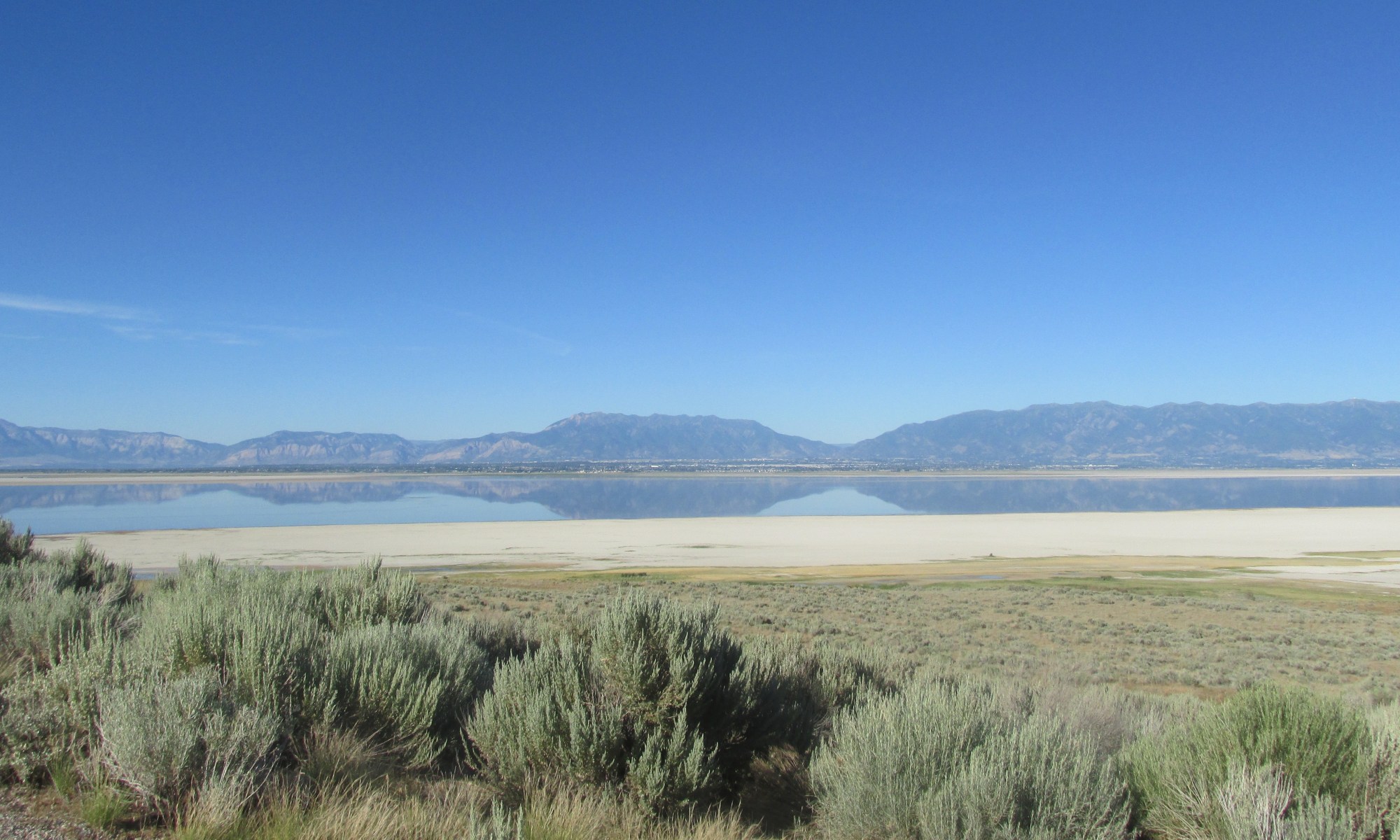
The tour ended, and once we had stepped outside again, we strolled over to a square brick building housing a bookstore and a gift shop, and Heather bought a snowflake ornament made completely out of salt from the nearby lake. Then, we left the grounds and headed north on Interstate 15 toward Antelope Island State Park, a series of rolling hills forming the spine of the Great Salt Lake. Along the way, a steady stream of neon lights and signage bedecking the city and its neighboring towns flashed by. Behind these, the Rockies rose impressively on the east and north; everywhere else, the taupe land sloped downward toward the lake or tapered off into a flat plain rushing toward distant mountains.
We arrived at the park entrance forty-five minutes later and discovered that a narrow land bridge served as an access point for the island. Halfway across, Heather pulled over. “I’d like to see the salt flats, if we could,” she said, so we disembarked and clambered over small boulders to reach the shore. At first glance, the sand appeared dirty, like a salt shaker with brown rice inside to absorb moisture, but when we began walking around, we realized the salt-encrusted ground was actually peppered with innumerable shrimp flies nervously quivering at our presence. I stood still for a few seconds, allowing the flies to land in a false sense of safety and then broke into a run through the crowd, creating great clouds of quietly whistling flies that rolled before me as if I were energy invigorating water into waves.
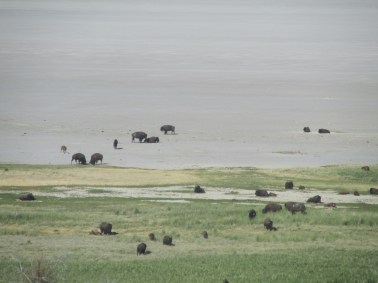
The day was beginning to wane, so we turned around and picked our way back through the rocks and past some of their arachnid inhabitants to the car. Once on the island, a road built into the contours of the its hills allowed us to spy on species of birds and rabbits I wasn’t familiar with as well as on families of bison grazing close to the water. Then, we came upon an old ranch where pioneers had lived as caretakers of the island. A plaque informed us that a few settlers in the 1800s had decided to bring a small population of bison over from the mainland to protect them from overhunting. Thanks to their efforts, these great creatures were still able to live peacefully in their refuge, isolated from the dramatic urbanization that had transformed the land just a few miles away.
With the sky darkening around us, I could see the outline of the city spread out along the shore of the lake in the distance, but only its lights penetrated here; no sirens or even voices disturbed the bison slowly migrating along the shore or the lone coyote hiding in the dried grass. Though only miles from hundreds of thousands of people, we were removed from the world for a moment. I was grateful for the silence and the calm after three plane flights and an afternoon in the city, but as the sun’s residue drained from the sky, it was time for our trio to leave the island.
Supper at In-N-Out would be the last item of the day. I had never been to the Western fast-food chain before, so I was on alert as soon as I walked through their doors. Their menu impressed me with its economy—I had just four hamburger combos to choose from—and after I ordered, I was sitting down on a ruby-red swivel chair with a milkshake in hand. But, to be honest, I cannot say the burger I ate made a lasting impression on me. The hour we three spent chatting and laughing, however, did. From differences between American and German culture to our favorite books and the cost of living in London, we talked until 8:30 or so over fries and beef, oblivious to everyone else in the restaurant.
Heather and I were reluctant to get started on the late night of driving ahead of us, but we knew we had an early morning the next day. We wrapped up our conversation and by 9:30 had located the hostel where Beate would be staying for the next few days. Though I had only met her eleven hours before, she already felt like an old chum to me by the time we bid her farewell.
Heather pulled out of the small parking lot and directed our car onto I-15 again, this time headed south. We had booked a room in the town of Panguitch, just outside of Bryce Canyon where we would be spending the next day, but when she saw the time, she shrieked. “David, it’s four hours to our motel and it’s almost 10:00!” Unfortunately for Heather, I at twenty-one wasn’t yet old enough to drive the Nissan per the rental car policy. So, I spent the hours in shotgun as silent moral support and looked up into the onyx sea above me, the silver stars more plentiful than anywhere I had been before, and felt my consciousness fade into sleep.
 The Barefooted Soul
Your vivid descriptions allow me to picture the scenes in my mind
LikeLike
As I read about your adventure I felt as though I was there! And I could hear the excitement in your voice. Well I could imagine it. I enjoyed reading it
LikeLike