

Saturday had arrived, and reaching for the lamp on the bedside table, I realized with a tinge of sadness that our trip was more than halfway through. Having already hiked and driven across deserts, up mountains, through canyons and into rivers I might have guessed we had been travelling for two or three weeks, not five days. My thoughts didn’t linger on these sentiments, however. Monument Valley, the icon of Hollywood westerns and the American West, was on the agenda, and by my estimation, we should be driving over its red earth around sunset. As my body began to tingle with anticipation and my mind flooded with the details of the day’s schedule, Heather rolled over on the other bed to face me.
“Hey, what do you think about going to the South Rim before Monument Valley?” she said.
My thoughts screeched to a dead stop. Before I could answer, I remembered something a park ranger on the North Rim had told us about a family who was planning to drive to the canyon’s other side. “Could you tell us where the bridge to the South Rim is?” they had asked. An innocent question, but for the ranger, it represented a gross misunderstanding about the park. The Grand Canyon is about ten miles across from the Grand Canyon Lodge on the North Rim to the South Rim’s visitor’s center, but there is no bridge or any other expedient means of crossing the gap unless you board a private aircraft. The only feasible option is to drive, a four-hour trek around the countless subcanyons which crackle off the main canyon and spiderweb across northern Arizona.
I tried to stay calm as our itinerary shattered inside my brain. For us, the additional stop would entail a minimum of three and a half extra hours on the road en route to southeastern Utah. I realized Heather had a right to the trip’s planning as much as I did, but I knew that if we didn’t punctually execute the hour-by-hour schedule I had painstakingly crafted in Virginia, something would have to give. In this case, that would be the flexibility we had built into the day and any chance we had of visiting Natural Bridges National Monument. “As long as we make it to Monument Valley by sunset,” I bargained with hesitation, acknowledging the near impossibility of this proposition, “I suppose…we can make a detour.”
By mid-morning, we had cleaned out the motel room we had stayed in since the night after our climb up Angel’s Landing, packed all of our increasingly dirty and disorganized detritus into the car, and pulled out of the town of Kanab with a new purpose.
****
A few months earlier on one of my travel guide binges, I had read that on this point in our travels we would be driving past an outdoor film set used in the TV series Gunsmoke. Since my dad was a fan of the Western, I thought the small pilgrimage would be worth our time. Ten minutes east of Kanab on Utah’s Route 89, I told Heather to hang a left  down a two-lane country road into Johnson Canyon, and after a couple minutes intently scanning our surroundings, a cluster of wooden storefronts and barns with clapboard siding came into view. The buildings hunched together a few hundred feet away on private property, so we stood behind a barbed wire fence bordering the road and used the zoom lenses in our cameras to get a better look at the facades. To my surprise, I didn’t see the gracefully aging buildings that had functioned as part of Gunsmoke’s setting for years; rather, my close-up view revealed boards warping into giant parentheses and roofs slowly bowing downward as if an invisible weight were
 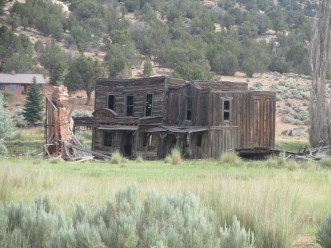 slowly crushing them. In contrast to the almost fanatical protection of nature I had come to expect in the National Parks, here it seemed that the set piece would eventually crumble into the tall, dry grass with no one to notice. I did what I could to preserve the town, framing the buildings and the ochre plateau rising behind it into a photograph, and then turned back.
Once we had made our way back to the main road, we turned our car toward Page, Arizona, our first city since Salt Lake City almost a week before. The desert gradually merged with the sprawling urban area as we neared it, but I would learn from a local guide that this town had been relatively insignificant until the Glen Canyon Dam was built nearby. About fifty years ago, this towering engineering feat had been constructed both to generate hydroelectric power and to control the waters of the unpredictable Colorado River as it entered the Grand Canyon; once the dam was in place, a steady stream of water flowing south along the Colorado piled up against the massive concrete wall and flooded the upper canyon to form Lake Powell, creating a desert oasis a stone’s throw from Page and attracting boaters and water sport enthusiasts ever since. Mark Woods writes in his book Lassoing the Sun that it is because of the Glen Canyon Dam that white water rafting in the Grand Canyon is a profitable and generally safe enterprise; before the speed and volume of the water could be manipulated, it was much more treacherous to go down the river since downpours miles upstream could send a deluge surging through the canyon without warning.
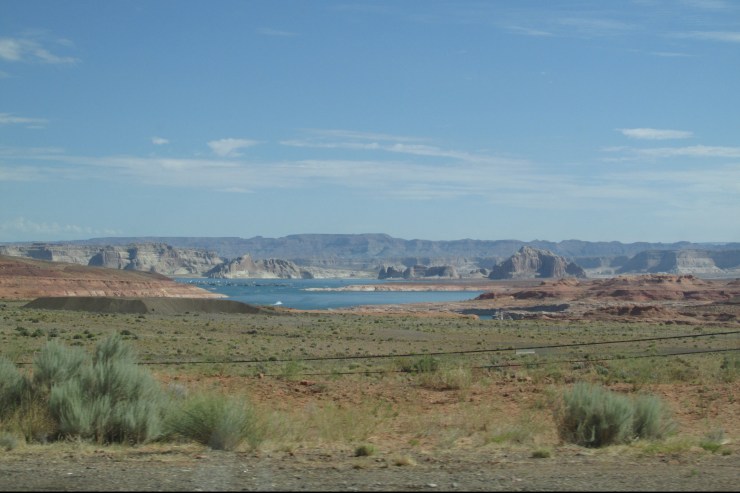
I could make out the lake a mile or two off the road, but ironically, the houses we passed had clearly been landscaped with water conservation in mind. Stones and native cacti replaced bushes and grass to complement the surrounding sand and reddish dirt. When an imposing white and blue sign appeared in the distance, however, my attention quickly shifted. Never have I been as excited to see a Walmart. When I was growing up, I had loathed the mega-store because we did our grocery shopping there every Friday night, and I was usually in charge of pushing our cart through a maze of pallets sitting along the aisles to restock shelves. But on this day, after driving through small towns with few chain stores save the occasional McDonald’s or Subway, I couldn’t wait for the chance to go inside an air-conditioned supermarket where I could find everything from moose tracks ice cream to Legos. Before we did anything else, however, our primary objective would be tracking down aloe.
Each morning that week we had applied enough sunscreen to give ourselves a ghostly pallor, yet that hadn’t stopped our shoulders and ears from acquiring a rosy hue. After locating the pharmacy, we treated ourselves to half an hour gawking at the high ceilings and the plethora of goods all around us. Then, back at the car we spread the cool, greenish goo on our shoulders. The salve felt like a cool wet blanket against my body, reinvigorating me for the rest of the day’s travels.
Heather and I travelled south out of town and around the easternmost reaches of the Grand Canyon which appeared as drop-offs in the otherwise flat desert. A couple of hours later in the monotonous terrain, a familiar NPS sign approached us, and once we had flashed our annual pass at the ticket booth, we encountered the melee that was the South Rim on Fourth of July weekend. Cars, trucks, and RVs crowded the two-lane road and vultured meager parking lots at scenic viewpoints.
On the way to the visitor’s center, we noticed throngs of people parking at a modest turnout and hurrying not toward the lookout but to a copse nearby. Our curiosity piqued, Heather pulled into a spot just vacated by another tourist, and we followed the masses with our cameras in hand, unsure what we might see. Fifty feet from the road, a twelve-point elk was nonchalantly ripping leaves off a short tree growing in the sandy  terrain. Isn’t it amazing that elk can still carry out their lives in their traditional habitats, I thought as I watched him forage, even if that entails having dinner within throwing distance of a mile-deep drop-off. Our semi-circle of gawkers swelled in number, cameras flashing every few seconds in the animal’s direction, and some began climbing through the brush to get a close-up shot just feet away from the elk.
Suddenly, a voice boomed behind us. “Excuse me, sir. I know you are not parked in the middle of the road!” I turned around and saw a park ranger in an SUV which was idling beside an empty black truck stopped in the west-bound lane. “I’m going to turn around up here and if you don’t have your vehicle in drive by then, you can bet that you are getting a ticket!” The ranger sped off down the road. A couple of guys in jeans took a few steps toward the truck, watching him as he drove away and, I guessed, trying to call his bluff. At the other end of the parking lot, however, the SUV made a sharp one-eighty and screeched as it accelerated back up the road. The driver and his buddy dashed to the truck as if they were being chased by the elk itself, and the pair jumped in and floored it just as the ranger arrived back at our gathering and stopped once more.
“Everyone, this is a wild animal! Do not get close to him,” he said commandingly as he got out and marched toward us. “Sir!” he called out in exasperation to a fellow not twenty feet behind the elk’s rump. “Will you please come back to the sidewalk!” Unwilling to learn the consequences of not obeying the ranger’s orders, the crowd thinned, and the glut of vehicles began moving normally again.
We joined the dispersing crowd and finally made it to the visitor’s center, its enormous parking lot large enough to accommodate numerous rows of rental cars and tour buses. A sidewalk a few yards from the rim of the canyon extended out of sight to the west, allowing you to walk to the myriad vantage points at the South Rim. Most people, however, had chosen to take buses designated for that purpose. Even though we had spent hours sitting in a car already, Heather and I were not inclined to make the trek on foot since our leg muscles were still reminding us of a steep section of the North Kaibab Trail we hiked the day on the North Rim. So, we reluctantly opted to join the bus queue.
An unbroken string of people snaked back and forth from the bus stop first underneath a shelter and then out into the sun; walking to the back of the line, I thought I must have found the human version of Zion’s Walter’s Wiggles. I crouched in the oppressive heat, trying to take advantage of the slivers of shade cast by a wooden fence beside the path, and began to realize how different the two rims of the Grand Canyon are from each other. Across this colossal chasm, I could make out the plateau I had stood on just twenty-four hours before. There, the land climbed about a thousand feet higher in elevation, and even as I sensed the sweat accumulating on my brow, I remembered the ice storm of the day before and the surprising chill that had accompanied it. Even the landscape contrasted markedly between the sagebrush and bushier trees on the south and the pines and spruces adorning the north. Of course, the most striking difference to me at the moment was in population. The line for the bus seemed to have as many people as I had seen on the whole North Rim.
Buses departed every eight minutes, and while we waited, it occurred to me that I could understand very little of what was being said around me. I was surprised to hear Mandarin and German spoken just as often as English, and as we inched forward, I realized that the couple in front of us was conversing in French. Having studied French in college, I distracted myself by snatching recognizable words from their speech until I found myself climbing up the stairs onto a bus right after them. I took my seat, thankful to be sitting once more, but then let a sigh escape from my lips. I knew being at Monument Valley by sunset was out of the question now: We were a three-hour drive away, and the sun had just passed its zenith on its way west. But mercifully, my disappointment wasn’t long-lived.
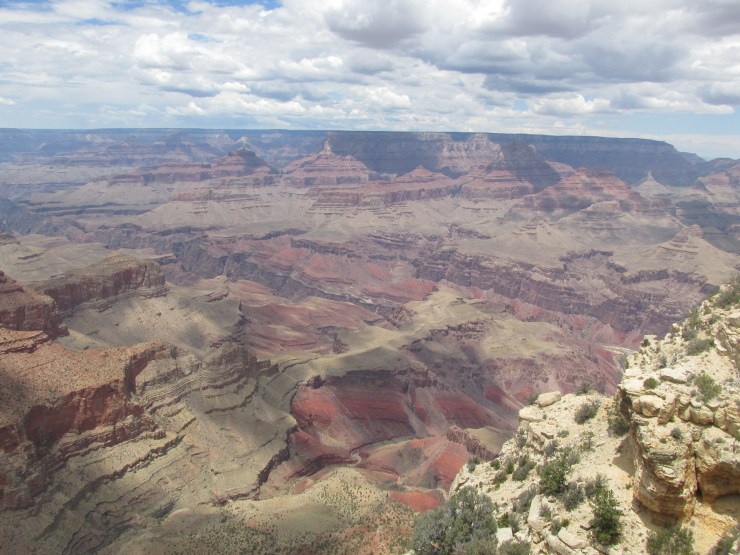
For the next couple of hours, we rode the bus and then strolled to some of the most breathtaking scenes of the Grand Canyon I had yet witnessed, each vantage working in tandem with the angle of the sun and the ever-changing hues on the stone to give a slightly different perspective on the vast gulley; the spectrum of auburns and ochres enchanted me as they illuminated the endless contours of the rocky hills. Some viewpoints jutted out into the abyss, making me feel like I was reenacting the “King of 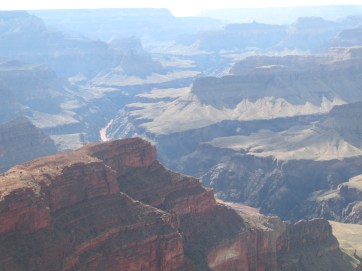 the World” scene from the Titanic while I gazed out over the unearthly terrain. I could swear the canyon’s immensity induced in me a sort of transcendental rush, making me lose my sense of reality for a moment, but despite the magnetic force drawing us to the railing, Heather and I both knew it was high time to call it a day. Our introverted selves needed a break from the crowds, and our bodies ached for a bed instead of a car seat.
We boarded another bus, heading back the way we had come, and after touring the parking lots and bus stops of Grand Canyon Village for half an hour, we returned to the visitor’s center at last and our familiar vehicular home. Heather retraced our route out of the park, and then we cut a northeastern route through Arizona toward Utah. En route, we stopped in the town of Tuba City for supper, and I must say I have never known a Denny’s breakfast skillet to be more satisfying than it was for me that night. The eggs sunny-side-up ran over roasted potatoes and chorizo sausage to create a most gourmet meal for my tired body. A four-dollar chocolate shake was probably overkill, but I told myself it was my reward for valiantly enduring NPS transportation.
A couple more hours of stars and a deep-blue desert carried us to a rustic motel in Mexican Hat, Utah by midnight, its flowerboxes spilling over with cacti and its rooms nestled into a modest cliff bordering a steadily flowing river.
 The Barefooted Soul
very enjoyable Made me go to a dictionary to look up a few words. What a word and picture article.
Thank you!
LikeLike