
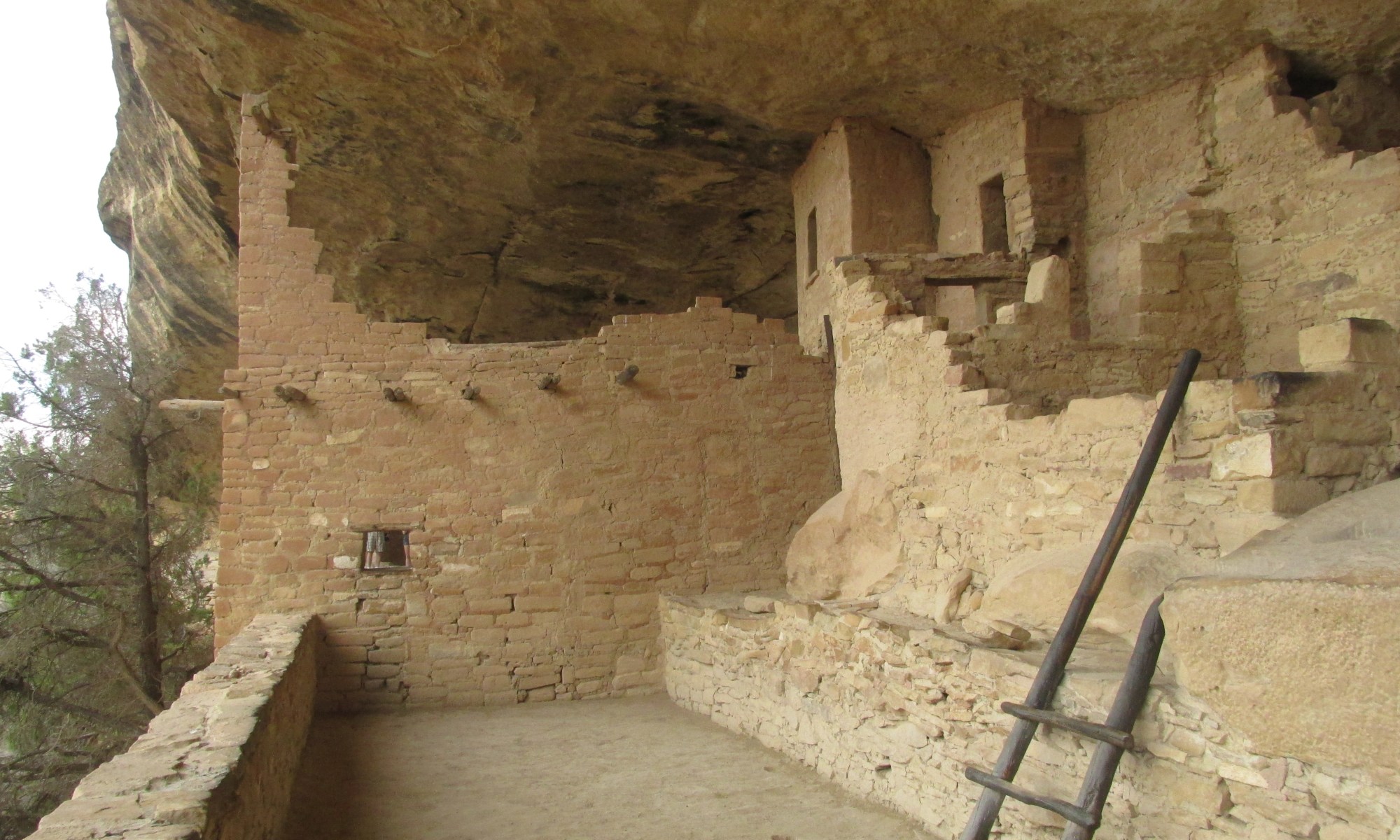
Less than a mile after we had pulled out of Four Corners Monument, we crossed into Colorado, the only state of the southwestern quartet we hadn’t yet visited. As we drove, the land rippled in anticipation of the Rockies, and grass appeared where only sand and stone had for most of our travels. Tucked into these surroundings was the fourth National Park I had pinpointed along our route: Mesa Verde.
Most of what I knew about the park I had learned in elementary school, and even then, I could only remember that the site was known for ancient cliff dwellings which had looked to me like sand-colored stacks of oversized Legos perched high above the valley floor. As a kid, I had imagined how it would feel to be an explorer peering over the edge of a cliff in the Colorado wilderness only to find a stone village huddled just underneath me. At twenty-one, what now intrigued me most about Mesa Verde was its distinction of being the first national park created to celebrate human achievement and history rather than to preserve a plot of land for its own sake. Though I had witnessed plenty of breathtaking vistas on our trip, I hadn’t been exposed to much of the area’s human story, and I knew there must be more to it than Gunsmoke and John Wayne.

By late afternoon, we had arrived at the park’s visitor center which was situated at the base of lofty, green hills instead of on the flat, dusty plains to which we had grown accustomed. On our way to the building’s entrance, we passed a Brancusi-esque sculpture depicting a man clinging to the side of a rock face with his fingertips and toes, his muscular body tense with the effort and a bulging sack cinched to his back. His weathered and weary appearance certainly didn’t mirror the romanticized picture of cliff dwellers I had imagined, making me wonder what I would encounter when I caught a glimpse of their world.
Most of Mesa Verde’s cliff dwellings require you to sign up for a guided tour to visit them, so Heather and I purchased tickets for a site called Balcony House. “The tour starts in about an hour, and it takes forty-five minutes to get down there, so I would go ahead and start that way,” a ranger at the information desk said as he smoothed out a paper map along the glass countertop and began tracing our route with a bright yellow highlighter.
Though I had assumed the park would be small in size, the route to Balcony House followed a twisting road which led all the way across the Chapin Mesa to the remote southern end of the park. Whereas Arizona highways sometimes reminded me of the impossibly straight and infinite lines of geometry class, here, the roads took more of an Art Nouveau approach to engineering. First, we climbed the verdant hills to an almost dizzying height overlooking southwestern Colorado; then, the organically flowing road conveyed us southward utilizing a series of tight switchbacks and gentle curves as if we were tracing the contours of a topographic map.
We eventually came upon the pavilion where we would meet our group, and sure enough, a park ranger, clothed in the usual gray collared shirt, forest green slacks and wide-brimmed hat, stood nearby, gazing out at the valley beside us. Our cluster grew to fifteen or so by the time of our tour, and then our guide turned to greet us and give us some background information on Mesa Verde. While he spoke, I noticed that our bearded leader wore a silver ring ornamented with turquoise, a precious stone which is said to bring respect to the wearer according to local Native American tradition. “We will be encountering ladders, tight spaces, and step stairs on this tour,” he said ominously as he concluded his introduction, “so if you need to stay behind for any reason, please do so. We won’t be able to turn back once we get going.”
The ranger led us down a path graced with bushes and short-statured trees which hugged the eastern slope of Chapin Mesa. After being in the park more than an hour without glimpsing any of the isolated villages the park was known for, I wondered when I would finally get to see Balcony House. Would we have to repel down into the village or would we round a corner and suddenly appear on its doorstep? I didn’t have long to guess: The narrow trail continued crisscrossing down the cliff face until we were suddenly confronted with a tall wooden ladder rising from the trail’s terminus. This was not an ordinary ladder, however: It had three vertical rails instead of two, and its rungs seemed wide enough to accommodate a giant.
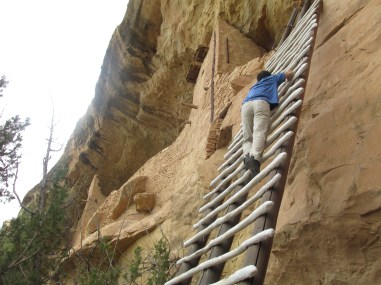
“In the 1930s and ‘40s,” our guide said as we pooled at the ladder’s base, “Franklin D. Roosevelt’s Civilian Conservation Corps was commissioned to come to Mesa Verde to make our sites more accessible to visitors. They did that by constructing roads, carving steps into rock faces leading down to the cliff dwellings, and in this case, building ladders.” He then motioned to the wooden structure, apparently wanting us to climb up after informing us it was at least seventy years old.
I hesitated. The ladder I was supposed to ascend had been exposed for years to natural elements like rain and wind which wanted nothing more than to bring about its demise. I did have another option if I wanted to see Balcony House without climbing up a ladder older than World War II: I could sneak away from the group, hike back up the lengthy and steep incline to our car, drive all the way back to the visitor center and buy a postcard. But, I didn’t want to let fear stop me now. Already on our trip, I had climbed up a mountain ridge narrower than the sidewalk in front of my house and ridden a horse who had been content to trot along cliff edges. So, I plucked up my nerve and waited for my turn. Even at home, I didn’t climb the rickety staircase into my basement at the same time as someone else in case it might collapse with our combined weight, but here the ranger loaded us onto the perilous ladder as soon as he was sure we wouldn’t get kicked in the teeth by the person above us. Hand over hand, I inched my way to the top, all the while feeling a constant quivering beneath my fingers from others ahead me. Once I reached the top rung, I carefully hoisted myself back onto blessed solid ground. As I stood up, the trepidation I had been feeling dissolved as I was greeted by the sight which had been silently awaiting us.
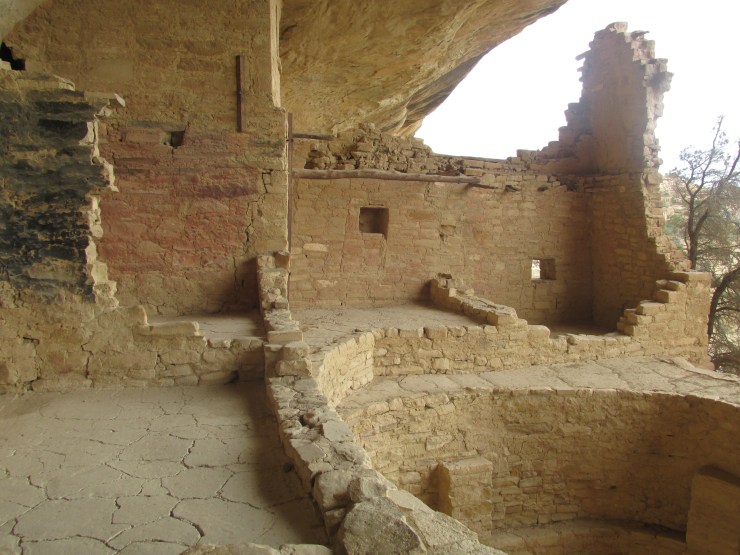
We now stood in an alcove recessed perhaps thirty feet into the mesa, and under the protection of the giant overhang of rock sat an array of off-white, sandstone homes. Many of the structures shared walls, and only a couple of feet separated the back of the complex from the natural stone. I didn’t know how many people had lived in Balcony House at one time, but these quarters must have been cramped if its residents had spent much time on this ledge together. The ground below us sloped steeply downward, and I was sure the ladder we had just climbed and the connecting trail hadn’t been around centuries before to provide easy access to the land above. “Why do you think the cliff dwellers chose to live in such an isolated location,” the ranger asked us, “especially when gathering food could easily have required them to climb back up to the plateau’s surface?” Clearly, the people who had built these homes had done so intentionally, making good use of the natural space around them, but why had they begun living here in the first place? Had they been protecting themselves from an invading tribe, or had the environment become hostile enough to drive them here? Remembering the sculpture at the visitor center, I doubted they had moved here for the view. There must have been an incentive to sacrifice the convenience of living on the plateau, but we could only speculate.
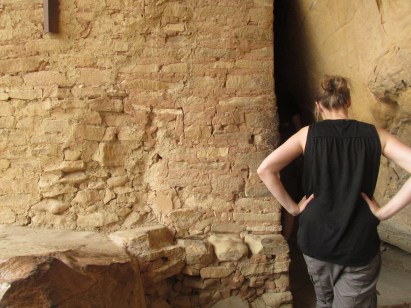
Our guide led us through Balcony House, our narrow path sometimes forcing us to climb over, squeeze past, and shimmy behind the structures. As I passed one of the homes, I stopped and peered through a window into an empty, pebble-strewn room. A millennium before, I might have been greeted by a family eating a meal or lying down to rest, but now their absence met my gaze. Although I was just feet from where they had lived, they stood on the other side of a vast chasm of time; I squinted to make them out, to understand them better if I could and learn about their lives, but they receded into the darkness before me. I took a step back, and the glossy, blackened surface of the window ledge caught my eye, the evidence of 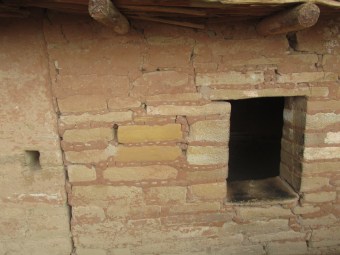 oily human hands which testified I wasn’t the first to look inward. I lingered there for a moment, and when I left, no one remained at the window, either on the outside looking in or the inside looking out, but their echoes permeated the stone around me.
At the end of the tour, our guide told us we would have to confront a “natural home security system” in order to leave Balcony House. He gestured toward a three-foot-high opening in one of the walls, and before I knew it, the shadowy hole began swallowing tourists on all fours as if they were kids heading for the ball pit at McDonald’s. The way I saw it, the cliff dwellers had, whether out of necessity or not, been daredevils. Climbing to the site would arouse anyone’s latent acrophobia, and the only manmade exit from Balcony House required a claustrophobic crawl through a stone tunnel.

My shoulders rubbed the walls on both sides as I knelt down and scooted my way into the opening. A few feet into the tunnel, a tiny room opened up, and a round, coffee-table-sized stone bulged out of the middle of the floor in front of me. I crawled around, thankful I didn’t have a fear of dark, low-ceilinged rooms, and squeezed through the exiting passage. Anyone who had wanted to intrude on the inhabitants of this community would certainly not have been able to do so quickly, unless they were toddlers.
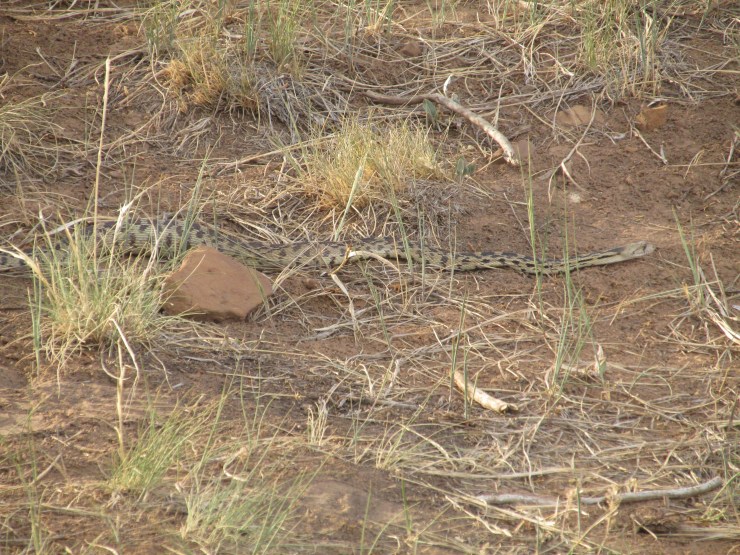
By the time we arrived back at the parking lot, the sun was lolling toward the horizon, but Heather and I decided to stop at a couple of self-guided sites on the plateau before we left the park. One contained the excavated remains of buildings even older than Balcony House and a nearby reservoir. While we tried to work out how the reservoir functioned, however, I noticed what looked like a coil of rope quivering on the ground in front of us. I grabbed Heather’s arm just before she treaded on a brown, freckled snake that looked as surprised as we were, but I knew he was probably better prepared to defend himself than two fatigued intruders with only a Nalgene half full of lukewarm water to use as a weapon. Needless to say, the two of us called it a day then and there and cautiously made our way back to the rental car.
 The Barefooted Soul
Wonderful to be there from your writing. Did you ever figure out what kind of snake your rope was?
LikeLike