
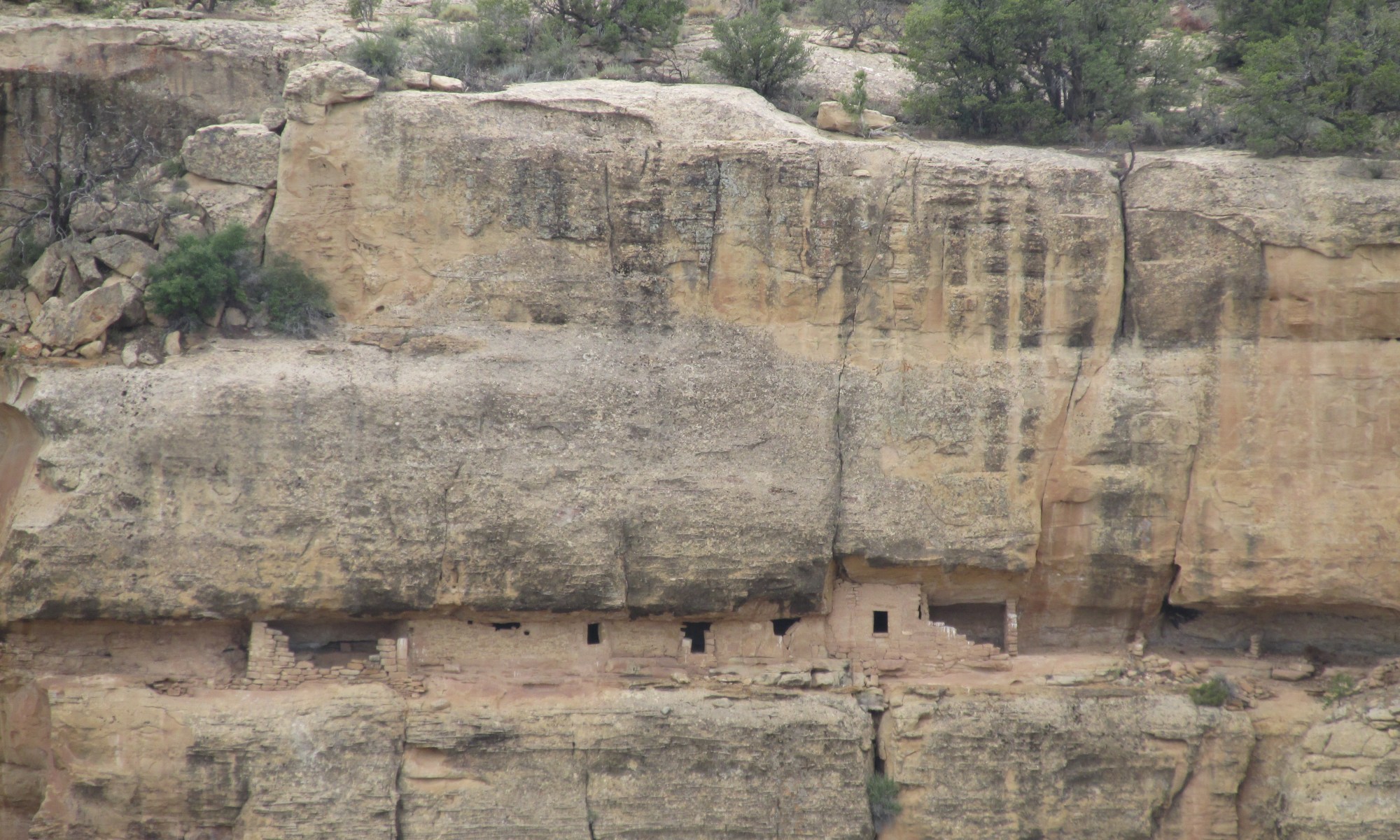
In the heat of the early morning sun, Heather and I made our way down a narrow gravel path to an outlook already clogged with hiking boots and dusty tennis shoes. After checking the time, I milled over to a wooden fence to look out over the valley below. This was our second day in Mesa Verde National Park, a crackling network of towering hills sprinkled with ancient cliff dwellings that is tucked into the corner of southwestern Colorado, and we were waiting to visit the largest and most well-known complex in the park: Cliff Palace. In contrast to the smattering of homes I had seen at Balcony House the day before, I could remember a photograph of Cliff Palace from my elementary-school textbook which revealed a veritable village with dozens of buildings, and I was excited to finally set foot in the site myself.
Hearing some commotion behind me, I turned around and recognized the familiar gray and hunter green of a national park uniform worn by a man ambling toward us. The bearded ranger greeted us jovially and introduced himself as a recent graduate of the University of New Mexico in anthropology and linguistics, a fact which piqued my interest since I would be starting my own linguistic graduate studies a couple months later. We waited a few minutes for stragglers to arrive, and then our guide gathered us into a coherent battalion and herded us down a chained-off section of trail which hugged the side of the cliff. We hiked beside an ever-growing rock face through a forest of hearty shrubs and trees which had somehow found their life source among the rocks. And then, as usually happens in the national parks, we rounded a corner, and I looked up from carefully navigating the uneven ground and came face to face with our destination.

Numerous sandstone rooms, some round and some square, sat carefully clustered underneath a giant stone awning which sheltered the dwellings from above. Rectangular openings sporadically carved into the walls formed windows and doors, and on one side of the village, a tower soared four stories into the air, its roof grazing the ceiling of rock. Whereas Balcony House had seemed compact and remote, this complex filled out its alcove ostentatiously with grandeur and craftsmanship.
Before we moved any closer, our guide ushered us into a natural alcove on the side of the trail and invited us to rest for a few minutes. While some leaned up against the stone cliff and unscrewed their Nalgenes, I sat down cross-legged in the cool shade and continued to gaze at the impressive site.

“What can we truly know about the lives and beliefs of a vanished people from the far side of a millennium?” the ranger asked, gesturing to the ancient structures. In stark contrast to the factually rich tour of the previous day, I was taken by surprise as he began introducing the site by expressing skepticism at the usual historical and cultural narrative of Mesa Verde. Where did the cliff dwellers come from? Why did they choose to isolate themselves by building their communities underneath the land which would have provided grounds to hunt and cultivate? And, why did they finally abandon the dwellings which they had taken such care to construct? These unanswerable questions hung tangibly in the air around us. Our guide challenged us to view the site for what it was: “All we are left with are bits of wood and rock arranged on the side of hill, shadows of the past,” he said. I thought of the empty buildings at Balcony House, the heavy spaces which had known the cliff dwellers intimately but now revealed little of their lives, like a photograph taken in darkness.
The ranger led us forward onto what might have been the central plaza of Cliff Palace, halting beside what appeared to be one of many shallow wells situated close to the homes. I carefully made my way to its edge and peered into what I could now see was a subterranean room about eight feet deep. An enigmatic arrangement of bricks and indentations lay along the diameter of the dusty, circular floor: first, a square opening at the base of the wall with a short barrier of bricks about a foot in front of it, then, a large round depression followed by a much smaller hole just big enough for a golf ball.

Our guide told us that this space was referred to as a kiva, meaning “ceremonial room” in the Hopi language. Though anthropologists originally thought this space functioned as a granary, most now believed this structure had spiritual significance for the ancient peoples who had lived here. The square opening in the wall would have provided fresh air for the people inside while the larger depression would have acted as a firepit; the brick barrier would have prevented gusts of wind from extinguishing the fire. But, the focal point of the room would have been the minuscule opening in the floor which I had almost dismissed. Referred to as the sipapu, the Hopi word for “place of emergence,” this hole represented the point from which the Ancestral Puebloans had emerged into this world. As I looked down at this spot with new eyes, I imagined moonless nights centuries ago when families might have gathered in the kiva around a crackling fire, their wide-eyed children leaning forward with anticipation as a storyteller gestured to the sipapu just inches in front of them and began recounting the story of their people’s origins and history.

After guiding us through other structures similar to those I had seen at Balcony House the previous day, the ranger took questions spawned by our now inquisitive minds and then led us toward the way out. In order to return to the car park high above our heads, we would have to climb up a series of narrow footholds hewn into the side of the cliff by Roosevelt’s Civilian Conservation Corps in the ‘30s and ‘40s. I followed Heather upward, hoisting myself up each stone step until I was forced to stop for a moment to catch my breath. Pausing, I took a drink of water, and then I noticed out of the corner of my eye a series of well-worn grooves running vertically up the cliff face. As I reached over and felt the grainy interior of one of these impressions, I remembered the sculpture at the park’s visitor’s center of a man clinging tightly to the side of a rock face as he climbed upward. Perhaps I was now in the presence of one of these ancient pathways by which the cliff dwellers accessed the surface.
Several minutes later, my legs relieved to find flat ground again, I made my way over to our ranger and thanked him for such an honest and thought-provoking talk. Then, before we parted ways, I thought to ask him about the slithering fellow that had surprised Heather and me on our walk the evening before.
“Oh, that’s probably a bull snake,” he said, looking at a picture I showed him on my camera. “I actually live inside the park, and I see them occasionally outside my house. Not venomous though. They’re constrictors.”
I looked over at Heather, my eyes widening. I was relieved to hear that the snake wasn’t close kin to his rattling cousins, but having the life slowly squeezed out of my body didn’t necessarily sound like a more appealing way to die in a national park. Sometime later, I did my own research and located an internet article which elucidated the matter, stating that bull snakes have enough strength to kill and consume rattlesnakes. So much for my peace of mind the next time I veered from the trail.
 The Barefooted Soul
enjoyed your visit. I learned about them from your work. had seen them before but did not know as much as I know now:0)
LikeLike